
What’s this all about?
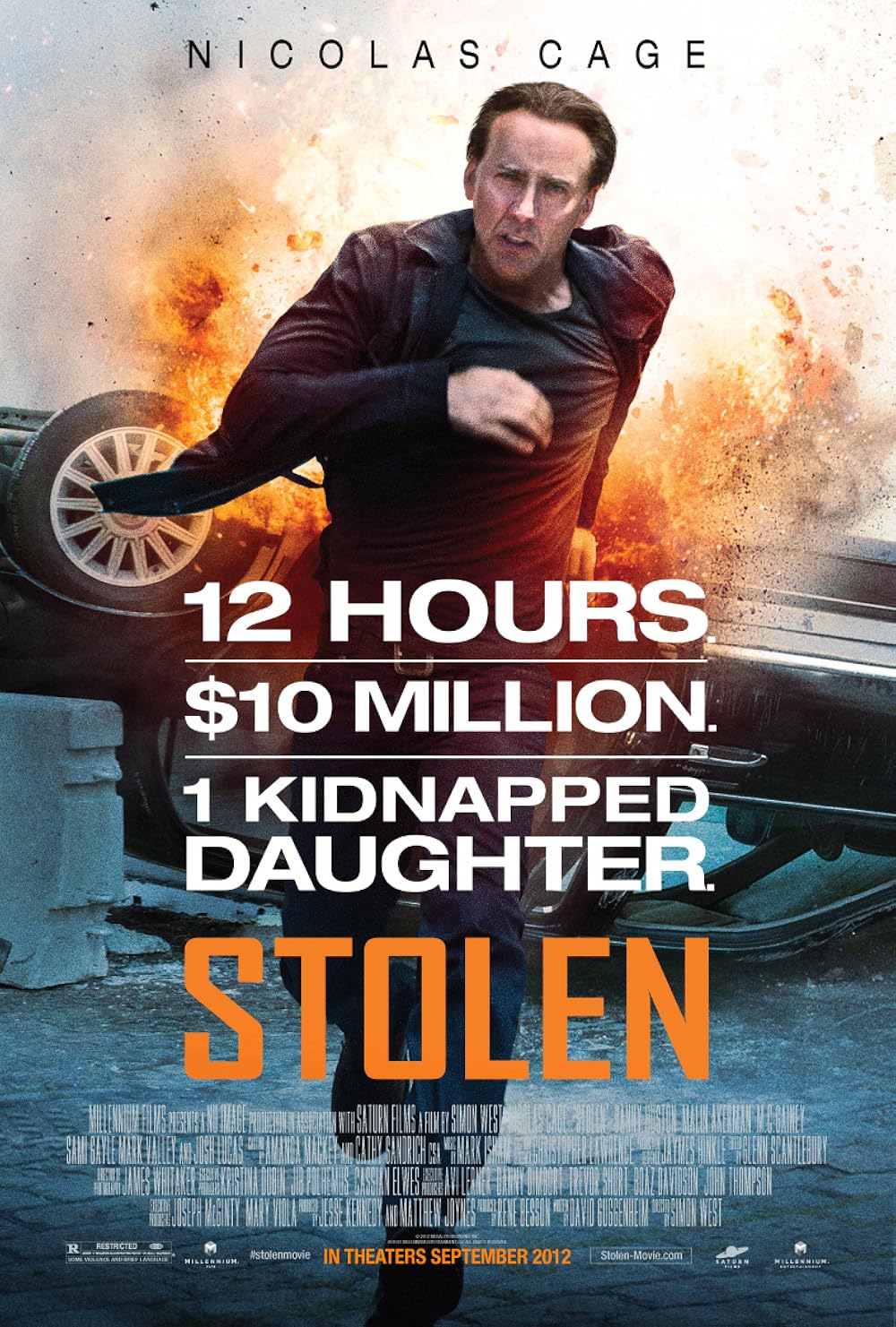
In 2012’s Stolen, a man with a mysterious past which has given him a peculiar set of skills learns that his daughter has been kidnapped, and only he can save her.
He goes on a wild adventure, foiling the intricate plans of his daughter’s captors, despite law enforcement and his friends trying to stop him from doing so.
No. I didn’t watch the wrong movie. Some screenwriter decided to copy his homework from his neighbor, and his neighbor was Taken.
In the Nick Cage version of the Liam Neeson classic, Nick, a former safe cracker/bank robber who has been released after serving his prison sentence, is back in New Orleans. Man, Nick makes a lot of movies set in New Orleans. Anyway, he longs to reunite with his daughter, but soon realizes that both the law and his former accomplices believe that he has hidden the haul from his final job.
Cars get chased, guns get shot, rooftops get jumped from and to, heists get pulled off, and gold gets melted. Stolen is a pretty standard Nick Cage action movie that gets a lot right, while making some familiar mistakes.
Who is Nick in this one?
Nick plays “Will Montgomery,” a criminal mastermind who was captured following a heist, when he prevents a co-conspirator from shooting a hapless janitor.
Who else is in this one?
M.C. Gainey (“Bo Crowder” from Justified) plays “Hoyt,” one of Nick’s former crew members.
Mark Valley (“Jack Devereau” from Days of Our Lives) plays “Fletcher,” an FBI agent chasing Nick.
Did you see that?
As Nick works on an impromptu heist, he is standing in a sewer beneath a bank vault, using an oxyacetylene torch to cut into the safe from below. He then uses the same torch to melt several gold bars in the vault, so that he can steal the gold without entering the vault.
Several times, the camera cuts to a digital display that is presumably inside the vault. What this display does is never explained, but it’s clearly quite important, as it’s shown many times, and it eventually turns red and sounds an alarm.
I paused the movie a couple of times, and finally figured out that it’s a thermostat, showing what is presumably the ambient Fahrenheit temperature inside the vault, the relative humidity, and the concentration in parts-per-million of some unknown airborne contaminant.
When the thermostat hits 106 degrees, it triggers an alarm.
For the life of me, I can’t understand what theater audiences were meant to take from this. The temperature alarm wasn’t explained, nor was the function of the thermostat. It just felt like somebody wanted a bunch of jump cuts, so we got this. -Michael
A man who’s been in prison for 8 years gets out in 2012 and can buy a cell phone from a kiosk and in under 3 minutes while running, unbox it, activate it, and set up call forwarding. Yep, that’s realistic. – Sarah
What were Nick’s best parts?
Upon his release from prison, Nick heads directly to the home of his now teenaged daughter. He convinces her to come with him to a cafe so that they can talk. She is obviously angry, and doesn’t want to talk to him. He starts awkwardly delivering a rehearsed speech, even pulling out notes at one point.
I think Nick did a great job portraying a nervous man who knows that he is delivering an important message. -Michael
I liked the scene where he begs his old partner to help him. It was convincing, felt real, and wasn’t over the top. He did a good job. – Sarah
What were Nick’s worst parts?
In the film’s final scene, we see Nick, his daughter, and his much younger female accomplice (who thankfully isn’t a love interest) relaxing at a cookout together, talking about future plans.
We soon learn that the FBI is watching, and that Nick has retained a loaf-of-bread-sized chunk of stolen gold. The FBI agents watch through binoculars as Nick debates throwing the gold into the ocean, so that it can’t be used to jail him.
One agent roots for Nick to throw the gold away, thus making his crimes unprosecutable, while the other hopes Nick will keep the gold, so that they can arrest him.
They’re literally watching him hold a piece of stolen property. I honestly don’t understand why they don’t just arrest him immediately.
The biggest problem with the scene, though, is Nick’s performance. It’s goofy and playful, and feels like a complete tone shift for a character who has been serious and intense throughout the rest of the film, even when talking to his young daughter.
This whole scene really feels like a focus group watched the movie without this scene, then complained about the lack of a tidy happy ending, and so they tacked this on to the end. -Michael
Nick did mostly an okay job on this film. He had a few good scenes and bunch of okay scenes, and then just a couple that he phoned in. I think the worst was during the scene where they have broken into the safe from below and have melted a bunch of gold, The female partner lets him know that the alarm has off and Nick says: “I just want to see if I can get a little more gold out of it.” The delivery was ridiculous and it completely broke from his character. It just felt out of place. – Sarah
How was the movie?
This was honestly a pretty good movie. It isn’t The Third Man or anything, but it’s a decent, fun script with several well-executed action set pieces, and decent acting throughout. The plot was interesting enough to hold my interest without being groundbreaking. If you’re looking for a “normal” action movie, this one is fine. It’s not really a “crime” movie, despite it featuring two bank heists, but it’s good.
The thing that I appreciated most is that they set up an easy but stupid twist that they didn’t use. When Nick is initially cornered by the police, he has $10 million dollars of stolen cash with him in a bag. When the police actually capture him, the money is gone.
After his release from prison, Nick tells the FBI (and his co-conspirators) that he had burned the cash, knowing that he’d get a lighter sentence if he didn’t have it on him. I don’t think that’s how sentencing works, but I believed that Nick’s character believed it.
The film plays up Nick’s “criminal mastermind” credentials, so it would have been an easy twist to reveal at the end that he had, in fact, hidden the cash. This would have been stupid, and would have cheapened the motivation of the main plot, and the screenwriters realized this, and didn’t pull a “he had the money the whole time!” maneuver.
That makes the weird gold nugget scene at the end even more perplexing, but I can give that a pass. -Michael
The movie was okay. The action was pretty good, Nick’s acting was mostly good, but unfortunately the plot was ridiculous and so was the writing. And the bad guy was a horrible actor. – Sarah
Yeah, but did you like it?
I found the movie to be fun and enjoyable. It’s too bad that it earned $18 million on a budget of $35 million. Give it a watch if you’re looking to kill some time. -Michael
I thought it was okay. Not bad for an evening at home. Just don’t go in with high expectations and you’ll be fine. – Sarah
Where can I watch it?
It’s free to stream. Can you guess where? Yep. Tubi. Enjoy!
Leave a Reply