
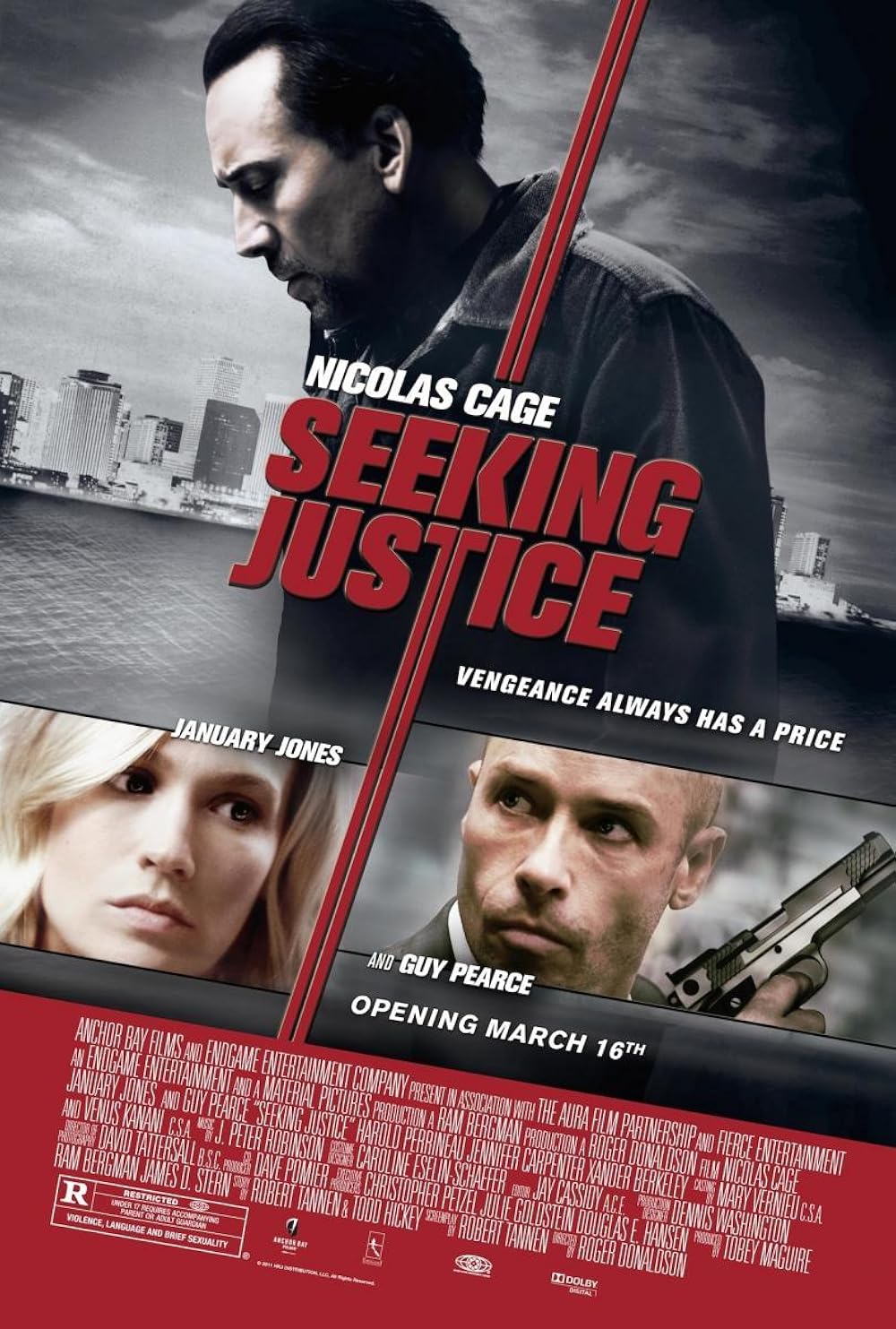
What’s this all about?
When a mild-mannered high school teacher’s wife is brutally assaulted and raped, he is lured into a web of murder, when a stranger approaches, and offers to have the wife’s assailant killed.
In exchange, the teacher is expected to undertake assignments for the shadowy vigilante organization, ultimately culminating in murder.
Everything spirals down the drain somewhat predictably. There’s some decent action along the way, even if the premise is highly dependent on coincidence and people behaving in ways that defy logic.
It’s a big change in gears from Drive Angry and The Sorcerer’s Apprentice, for sure.
Who is Nick in this one?
Nick plays “Will Gerard,” a passionate high school English teacher. Nick’s performance is generally good, although I feel like any of a hundred other Hollywood actors could have replaced him and not really changed the film, much.
Who else is in this one?
January Jones (Mad Men) plays “Laura Gerard,” Nick’s wife. She’s fine, although she’s 14 years younger than Cage, which, of course, feels weird.
Harold Perrineau (“Michael” from Lost) plays “Jimmy,” one of Nick’s long-time friends, and fellow educator (maybe he’s Nick’s boss?). He’s in on the whole scheme for reasons that make no sense.
Jennifer Carpenter (“Deb” from Dexter) plays “Trudy.” I honestly don’t know what her role was. Was she Harold’s girlfriend? Nick’s friend? It’s not really explained well. Also, am I the only one who noticed that the entire supporting cast is made up of actors known for secondary roles in big TV shows?
Xander Berkeley (“Gregory” from The Walking Dead) plays “Lieutenant Durgan,” a New Orleans police detective who might be in on the whole vigilante murder organization. Or not.
Did you see that?
Early in the film, we see Nick meet up with Harold for a night of chess at a chess club. Where I’m from “chess clubs” are groups of chess players who meet in church basements and library activity rooms. toting their folding boards and their pieces.
In this film, a “chess club” is a tavern-like establishment that is permanently set up for, and entirely dedicated to chess playing. The tables and their boards are permanent. The only thing that you can do there is play chess. During the scene, the “chess club” is packed with people and bustling with noise.
Is that a real thing? How does that business model work? At a pool hall, you play per game played, but you can also buy drinks. Is that how this works? Do you just play chess against whatever strangers happen to be there that night, or is it scheduled like bowling leagues?
New Orleans is a weird place. Maybe this scene was entirely accurate, but to me, it looked like something out of a fairy tale. -Michael
The bathroom scene at the monster truck show has all the guys peeing in a trough urinal, but there was also a sign above that reminded them to flush. I know I’m a girl, and maybe I’m wrong on this, but I didn’t think trough urinals flushed. -Sarah
What were Nick’s best parts?
At one point, Nick is accused of having murdered an investigative reporter. Nick sneaks into this reporter’s workplace late at night to try to learn what’s behind this plot. The workplace is a stereotypical newsroom with several mostly-open cubicles. Nick arrives late at night, and sees another reporter working at her desk, so he subtly sits in the victim’s desk and pretends to be working.
After several minutes, the woman notices him, and yells at him, only to ask a question about the proper capitalization of a hyphenate word.
Nick pauses for a second, and then delivers an explanation that could have come directly from the mouth of an English teacher. It was the kind of explanation I’ve heard dozens of times from educators, and Nick delivered it perfectly. -Michael
I enjoyed the scene at his wife’s bedside in the hospital. He played the emotions of seeing his wife in the condition she was in and knowing what had just happened to her well. The emotions were raw and very believable. It made me feel for his character. -Sarah
What were Nick’s worst parts?
Nick is shown teaching Shakespeare to a rough bunch of kids in the classroom early in the film. I assume that the scene is supposed to show us that Nick is a passionate educator. Unfortunately, he shows us this by delivering a rapid-fire delivery of a few lines of Shakespeare like he’s in some sort of reading race. It shows intensity, but it comes across as nearly incomprehensible.
In a later classroom scene, Nick has to stop two students from physically fighting. Almost immediately afterward, he leaves the classroom completely unattended to go freak out about something.
I’m starting to think that Nick’s not a very good teacher. -Michael
I have to agree about Nick not being a very good teacher. My least favorite scene is the one where he returns home after punching a student. His emotions and how he treated and reacted to his wife just didn’t make sense to me and weren’t delivered in a particularly believable way. Really it was a combo of bad writing and bad acting. -Sarah
How was the movie?
I’m sure that the pitch for this movie sounded great. It probably went something like, “A man, blinded by anger and grief after his wife is raped, is approached by a stranger who offers to have the wife’s assailant killed. After the deed is done, the man is expected to commit a murder to avenge some other victim in a pay-it-forward scenario. The target of the murder turns out not to be a child molester, but a reporter working to expose the murder swapping organization. Drama ensues.”
It sounds like it could be cool. I’ll bet Hitchcock could have done something with that.
Unfortunately, the writers and director of this film really couldn’t. They fail to execute the premise from the beginning. The stranger approaches Nick in the hospital and tells him that the same man had raped his own wife months before, and offers to have him killed, seemingly for nothing in exchange.
Why would this man be willing to have the rapist killed for raping Nick’s wife, but not from raping his own?
Then, after the initial murder, the man begins insisting that Nick undertake assignments for “the organization.” Nick protests, but the man tells him that he’s obligated. Why? Nick never agreed to this. Nick never did anything that would be blackmailable/prosecuteable related to the first murder. It seems like he could have just said, “sorry pal, I don’t think we know each other,” and been done with it.
During the film, it is revealed that “the organization” is, in fact, huge, with nearly every character in the film being a part of it. If that’s the case, why is “the organization” trying to kill Nick? The man they wanted dead is dead. They have evidence proving that Nick didn’t kill him, so it’s not going to go to court. Surely, they could have just done nothing and gotten exactly what they wanted. It wasn’t like Nick was actively trying to expose them at that point.
The entire setup seems to be that this organization finds a criminal that needs killing, and gets someone with a vested interest to agree to having the murder happen. Somebody unrelated to the victim or his crimes is given all of the information that he needs to kill that person. Once that’s done, the person who agreed to the murder will need to execute a murder on behalf of someone else.
This all seems to be designed so that a person kills some other assigned person that they don’t know in any way, and thus can’t be connected to the crime, and is then “done.” Yet we see several characters who appear to be basically full time employees of “the organization.” Surely that would expose the entire operation to discovery, and short circuit the whole idea.
Tactically, the setup of “the organization” and the actions of its members don’t make any sense. -Michael
The premise of the movie at the beginning was just so far fetched and unrealistic, it was hard to get into things. See more details above on this. But half way through it did pick up and in the end I would say the movie was okay. -Sarah
Yeah, but did you like it? (Michael/Sarah)
As a throw-away thriller on a Friday night, it was just OK. -Michael
I liked the second half of the movie okay, but to be honest, if I hadn’t committed to watching it, I would have abandoned before it made the turn. So I guess my answer is that the movie is meh. – Sarah
Where can I watch it?
It’s free on Tubi, as usual.
Leave a Reply